
 EN
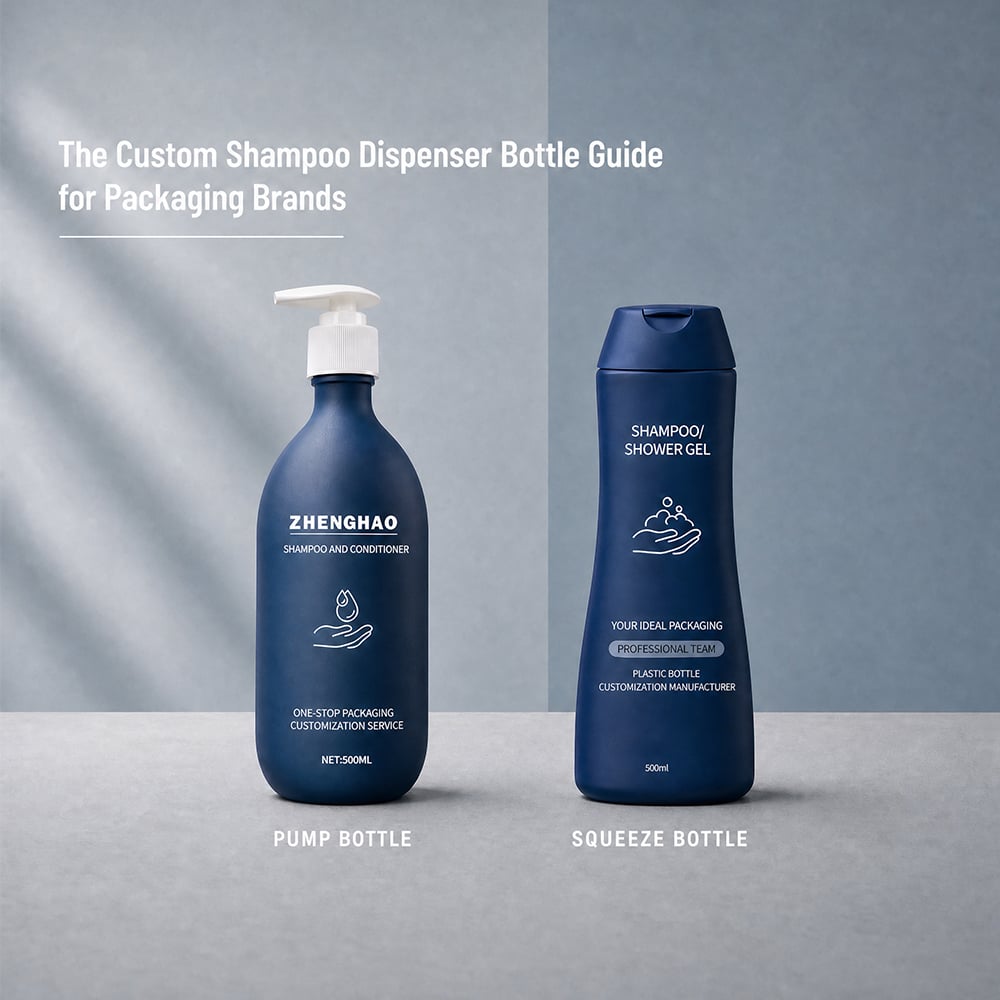
A shampoo package can look right in a product photograph and still fail in the shower. A pump may hesitate when the formula is too dense. A flip-top cap may seep inside a travel carton. A disc top can be quick to open but awkward for a wet or one hand. These are not minor component choices. They determine whether a consumer experiences a shampoo bottle as convenient, premium, portable, or simply annoying.
For private label brands, indie hair care startups, and established cosmetic lines, choosing between the shampoo dispenser bottle with a pump mechanism and a squeezable container is one of the most critical structural decisions in product development.Selecting the right packaging is rarely just about holding a liquid; it is the physical touchpoint of your brand's promise.
At Zhenghao Packaging, as a custom plastic bottle manufacturer and B2B OEM supplier, we regularly walk engineering and procurement teams through this exact crossroads. Both dispensing formats offer distinct commercial, mechanical, and aesthetic benefits. This comprehensive guide breaks down the fluid dynamics, material compatibilities, and manufacturing considerations behind both styles to help you build the ideal custom packaging solution for your hair care line.
Matching the Format to the Brand's Market Position
The dispensing mechanism communicates something to the customer before they ever use the product. And that communication needs to align with where your brand sits in the market.Choosing between an press pump or squeeze bottle format estblishes distinct positioning across different consumer touchpoints.
For the shampoo pump bottle:
From the perspective of brand communication concepts pump bottle says "salon." It says "professional." It says "this product is worth the shelf space on your bathroom counter." The extra cost per unit is part of the value proposition—it signals that the brand invested in the packaging, not just the formula. For premium hair care lines, salon brands, and products positioned on efficacy and experience, the pump is the expected format. A premium shampoo in a squeeze bottle feels like a compromise.
From the perspective of considering the end-user scenarios for the brand,example large-format 500ml or 1000ml containers intended for permanent placement on a shower ledge benefit significantly from a shampoo pump bottle format. In a wet, slippery environment, picking up a heavy, smooth bottle with soapy hands increases the risk of drops and spills. A stable, wide-base dispenser bottle allows users to extract a precise 2cc or 4cc dose with one hand, delivering an effortless, spa-like experience.
For the shampoo squeeze bottle:
Squeeze bottle says "practical." It says "travel-friendly." It says "I'm not trying to be fancy—I'm trying to work." For value-priced lines, family-size formats, and products where convenience matters more than ceremony, the squeeze bottle is the honest choice. It doesn't pretend to be something it's not. And for many consumers, that honesty is exactly what they want.
From a practical perspective, 100ml to 250ml capacities tailored for travel bags, gym totes, or compact shower caddies, a shampoo squeeze bottle is often the superior choice. Squeeze formats eliminate protruding pump actuators that can snag or unlock inside luggage. Furthermore, a flip-top or disc-cap bottle allows users to quickly invert the container to extract every last drop of product, appealing to value-conscious consumers who dislike leaving residual formula trapped at the bottom of a rigid container.
How Viscosity Dictates Your Dispensing Choice ?
This is the part that causes the most production headaches, and it's the part most Emerging brand owners discover too late.A common misstep among growing cosmetic brands is selecting a container based solely on visual rendering before running lab-grade viscosity tests.
Shampoo formulas vary enormously in viscosity. A clear, watery gel behaves nothing like a thick, pearlescent cream.
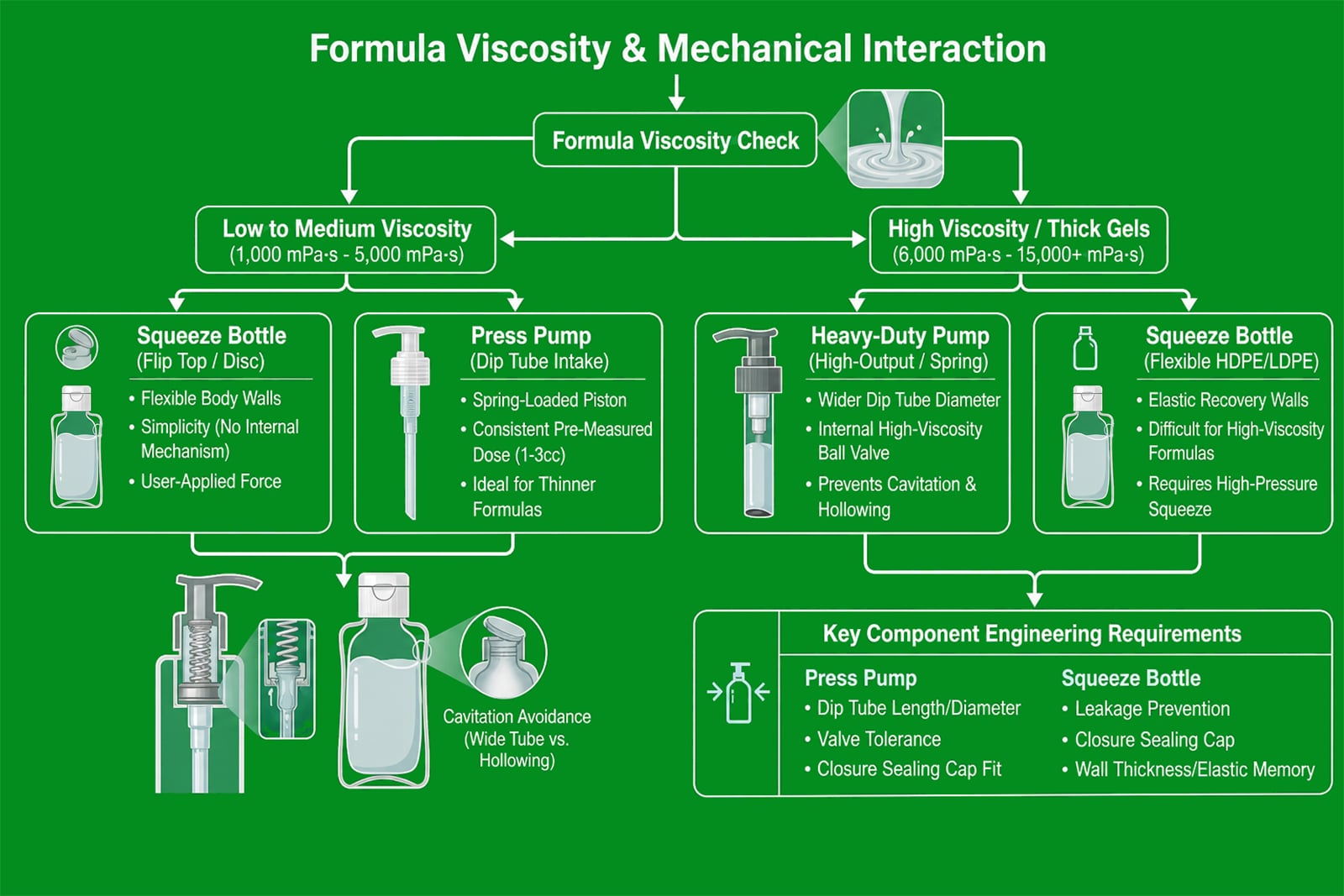
For thinner formulas—viscosity below roughly 3,000 mPa·s flip-top squeeze bottle is often the practical choice. The product flows easily under minimal pressure, and the flip-top's simple plug seal is adequate for controlling the flow. But a flip-top's sealing mechanism is weak by design. Most flip caps have a small plug that fits into the bottle opening, held closed only by hinge pressure. Over time, the hinge loosens, the plastic flexes, and the plug doesn't fit as tight as before. After a few hundred flips, it starts to leak or let air in. For a thin shampoo, that's a problem waiting to happen during shipping.
For thicker formulas—viscosity above 8,000 mPa·s pump is usually non-negotiable. The product won't flow through a flip-top opening without significant force, and a squeeze bottle would require an uncomfortable amount of hand pressure. A pump solves this by drawing the product up through a dip tube with mechanical leverage. But here's the catch: a pump that's calibrated for a standard lotion will struggle to draw a thick, gel-like shampoo if the dip tube diameter or piston tension isn't matched to the viscosity. A pump that works perfectly on a 2,000 mPa·s formula may fail completely on an 8,000 mPa·s formula.
This is where working with a shampoo bottle manufacturer who actually tests with your formula matters. At Zhenghao, we run compatibility testing with the actual product before committing to production—not just a generic "HDPE is compatible with shampoo" check, but real performance testing with your specific viscosity and surfactant system.
The Structural Comparison for Two Type Shampoo Packaging
Let's start with what's actually happening inside the bottle, because the mechanical differences drive everything else.
shampoo pump bottle uses a spring-loaded piston mechanism. When a consumer depresses a standard dip tube on a basic lotion bottle with pump, a vacuum is created inside the internal chamber. If the shampoo is too viscous, it refuses to level out over time. Instead, the dip tube pulls air through a hollow channel carved directly down the center of the formula—a phenomenon known in manufacturing as "cavitation." To prevent cavitation in thick formulations, a specialized pump bottle for shampoo must feature a wider dip tube diameter, an internal high-viscosity ball valve, or be paired with a flexible container wall that collapses slightly under pressure.Each full press delivers a consistent, pre-measured dose—typically between 1cc and 3cc depending on the pump specification.
The squeeze bottle has no internal mechanism at all. The bottle body itself is made from a flexible material, and the user applies pressure directly to force product out through a flip-top or disc-top cap. No spring, no piston, no dip tube—nothing that can fail mechanically.That simplicity is the squeeze bottle's greatest strength. For the liquid discharge device of the compression bottle, factors such as the bottle mouth size, the sealing cap fit, the length of the infusion tube, and the compatibility of the components all affect the discharge effect and the risk of leakage. Therefore, ensuring no leakage and that the discharge effect meets expectations is the foundation of the compression bottle.But it's also its limitation. Without a metering mechanism, the dose depends entirely on how hard the user squeezes. For a thin formula, that means inconsistent dispensing and product waste. For a thick gel, it means a workout for the hands.
Shampoo Dispenser Bottle Leak Prevention:important Details
Leaks are the number one complaint we hear from brands that switched suppliers mid-production. And the root cause is almost always one of two things: the pump lock wasn't designed for shipping conditions, or the flip-top seal wasn't specified for the formula's viscosity.
For pump bottles, the most effective anti-leak feature is a left-right lock mechanism. This works by integrating a rotating lock between the screw cap and the pump head. When the pump head is twisted to the "lock" position, a raised tab on the cap aligns with a recess in the pump head, physically preventing the actuator from being pressed down. Turn it to the right to lock for shipping, turn it left to unlock for use. A patent filing for this mechanism describes it as a "rotation-type locking device" that prevents liquid leakage by stopping the pump head from being pressed by external forces during transport. It's a simple design, but it requires precise mold tolerances—if the tab and recess don't align within a fraction of a millimeter, the lock doesn't engage, and you're back to square one.
For squeeze bottles, the key is the plug seal. A flip-top cap with a properly sized plug creates a mechanical interference fit with the bottle opening. The plug compresses slightly when the cap is closed, creating a seal that prevents liquid from escaping. But the plug only works if the bottle opening's inner diameter is held to tight tolerances. If the opening is too large, the plug doesn't compress enough. If it's too small, the plug won't fit at all. This is why we specify and inspect the neck finish dimensions on every production run—a 0.1mm deviation in the opening diameter can be the difference between a sealed bottle and a leaking one.
The testing protocol matters as much as the design. A drop test at counter height tells you if the bottle survives impact. A vacuum test tells you if the seal holds under pressure changes. And a 24-hour inverted storage test tells you what will happen during shipping when the bottle sits on its side for hours. A serious shampoo bottle factory runs all three before shipping, not just one.We once had a product bottle. Under normal circumstances, the product did not leak at all, not even when it was upside down forcefully. However, after the drop test, the bottle will gradually leak after being left stationary for some time. Therefore, in Zhenghao, we all undergo the drop and stationary test. After the drop test, we ensure that there will be no leakage within 36 hours.
Material Compatibility: Rigid PET or Flexible HDPE
No matter which type of bottle is chosen, the correct selection of materials cannot be avoided. We have discussed the issue of materials many times before.
Rigid Containers for Pump Mechanics
For the pump type, PET and HDPE are the conventional choices. The choice mainly depends on the brand concept and the nature of the liquid. For instance, plant extracts prefer PET as it allows the end users to clearly see the liquid form.A high-clarity PET shampoo dispenser bottle provides a premium, crystal-clear presentation that showcases formula colors and suspended pearlizing agents. Because PET maintains structural rigidity under top-load pressure, it serves as an ideal base for heavy-duty lotion pumps. When a user presses down on the actuator, the PET body resists bowing or buckling, ensuring that all downward force is transferred directly into the pump mechanism.
While HDPE is relatively inexpensive, when combined with appropriate surface treatment techniques such as sandblasting or soft-touch, it can also achieve high-end packaging effects.
Flexible Containers for Squeeze Mechanics
When designing squeeze bottles for shampoo, flexibility and elastic memory are non-negotiable. HDPE and LDPE resins allow the bottle walls to compress under gentle hand pressure and snap back to their original silhouette without creasing or stress-whitening. If a brand attempts to use rigid PET for a squeeze-dispensing top without a pump, consumers are forced to shake or strike the bottom of the bottle, diminishing the perceived value of the product.
During blow molding, wall thickness distribution is carefully controlled. In a real-world production test conducted for an Australian organic salon line, adjusting the side-wall distribution on a 500ml HDPE container from 0.8mm down to a uniform 0.65mm reduced resin consumption by 14% while retaining full elastic recovery after 500 consecutive squeezes. Achieving this balance requires precise mold temperature control and calibrated blow ratios on the factory floor.
Preventing Leaks in E-Commerce and Global Logistics
A packaging design can look stunning on a retail shelf, but if it leaks inside a shipping carton, brand reputation suffers instantly. E-commerce distribution subjects plastic pump bottles for shampoo to rapid atmospheric pressure shifts, vibration, and drop impacts.
Transit Security Comparison
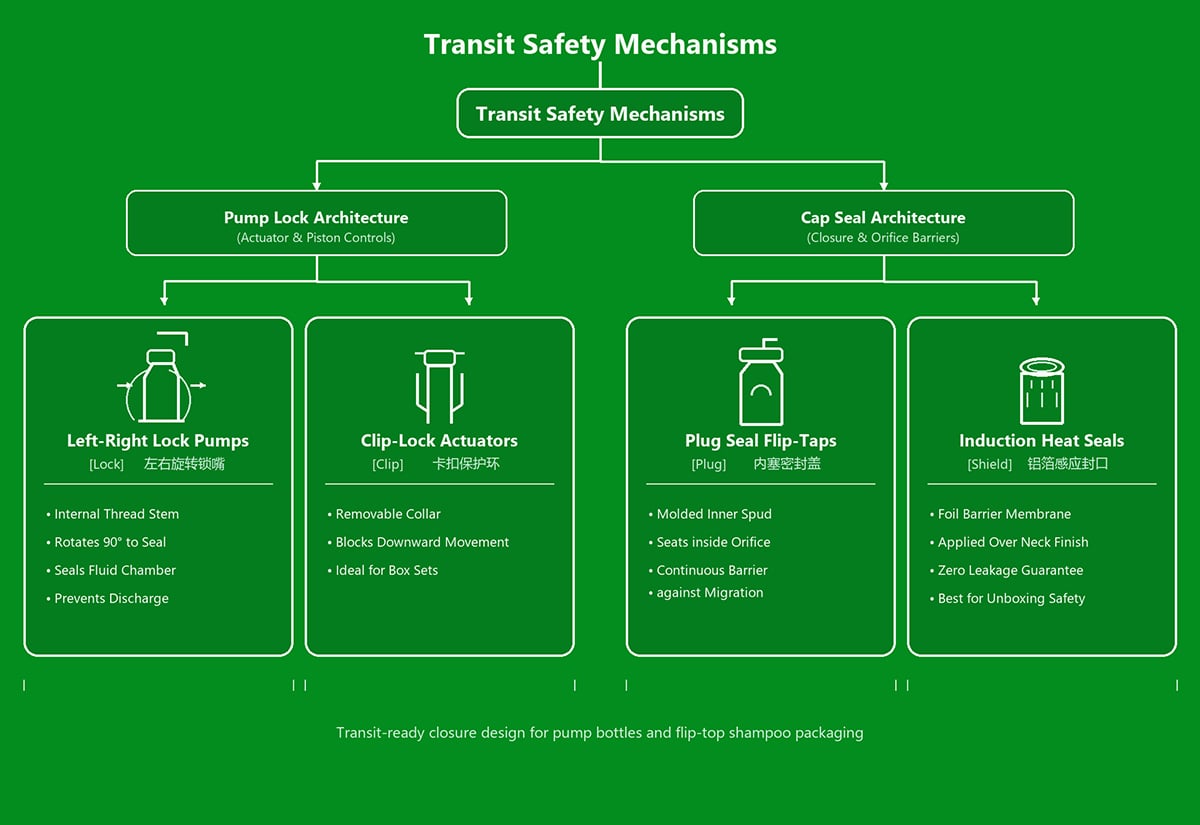
 Left-Right Lock Pumps: Feature an internal threaded stem that completely seals the fluid chamber when rotated 90 degrees, preventing accidental discharge during transit.
Clip-Lock Actuators: Utilize a removable collar beneath the pump head to physically block downward movement, ideal for retail displays and subscription boxes.
Plug Seal Flip-Taps: Incorporate a molded inner spud that seats directly inside the cap orifice, creating a continuous barrier against liquid migration.
Induction Heat Seals: Foil barrier membranes applied over the neck finish to guarantee zero leakage prior to initial consumer unboxing.
For a custom shampoo bottle utilizing a pump system, atmospheric pressure drops during air freight can force trapped air to expand inside the bottle, pushing liquid up through the dip tube. To counter this, custom factory tooling integrates micro-venting channels within the pump closure. These vents equalize internal pressure without allowing liquid to escape.
For squeeze configurations with flip-top or disc-top closures, the bottle neck finish must maintain strict thread tolerances. Our production lines utilize automated optical inspection systems to measure neck finish dimensions down to ±0.15mm. This level of precision ensures that the cap's internal plug seal aligns perfectly with the bottle mouth, forming an airtight barrier that survives standard ISTA 3A transit testing.
Manufacturing & Customization: Partnering with Zhenghao Packaging
Navigating the technical choices between material grades, neck finishes, and closure mechanics requires an experienced manufacturing partner. As a specialized B2B factory and custom supplier, Zhenghao Packaging bridges the gap between creative packaging concepts and high-speed industrial reality.
Our manufacturing capabilities support complete OEM and ODM customization:
Custom Mold Development: We design and cut custom blow molds in-house, enabling unique bottle geometries, ergonomic hand-grips, and embossed brand logos.
Color Matching & Surface Finishing: From UV-protective amber and soft-touch matte coatings to high-gloss metallization and silk-screen printing, we match exact Pantone specifications.
Sustainable Material Options: All empty shampoo bottles with pump or squeeze caps can be produced using up to 100% Post-Consumer Recycled (PCR) PET or HDPE resins, helping your brand hit sustainability milestones without compromising structural strength.
Rigorous Quality Control: Every production batch undergoes full-spectrum leak testing, vacuum decay assessments, and top-load strength verification.
The choice between a pump and a squeeze bottle isn't about which is better. It's about which is right for your formula, your brand, and your customer. A pump delivers controlled dosing and a premium feel, but it costs more and leaves more product behind. A squeeze bottle delivers simplicity and economy, but it depends entirely on the formula's viscosity and the cap's seal quality.
The details that matter—the left-right lock on a pump, the plug seal on a flip-top, the tolerance on a neck finish—are the details that keep your product inside the bottle and your customers coming back. And those details are where a shampoo bottle manufacturer who actually understands the engineering makes all the difference.
Whether you are launching a new hair care collection or scaling an existing product line, optimizing your packaging structure is essential for long-term growth. Contact our engineering team today to request sample kits, discuss technical drawings, or receive a competitive factory quote for your next custom packaging project.
Table of Contents
- Matching the Format to the Brand's Market Position
- How Viscosity Dictates Your Dispensing Choice ?
- The Structural Comparison for Two Type Shampoo Packaging
- Shampoo Dispenser Bottle Leak Prevention:important Details
- Material Compatibility: Rigid PET or Flexible HDPE
- Preventing Leaks in E-Commerce and Global Logistics
- Manufacturing & Customization: Partnering with Zhenghao Packaging